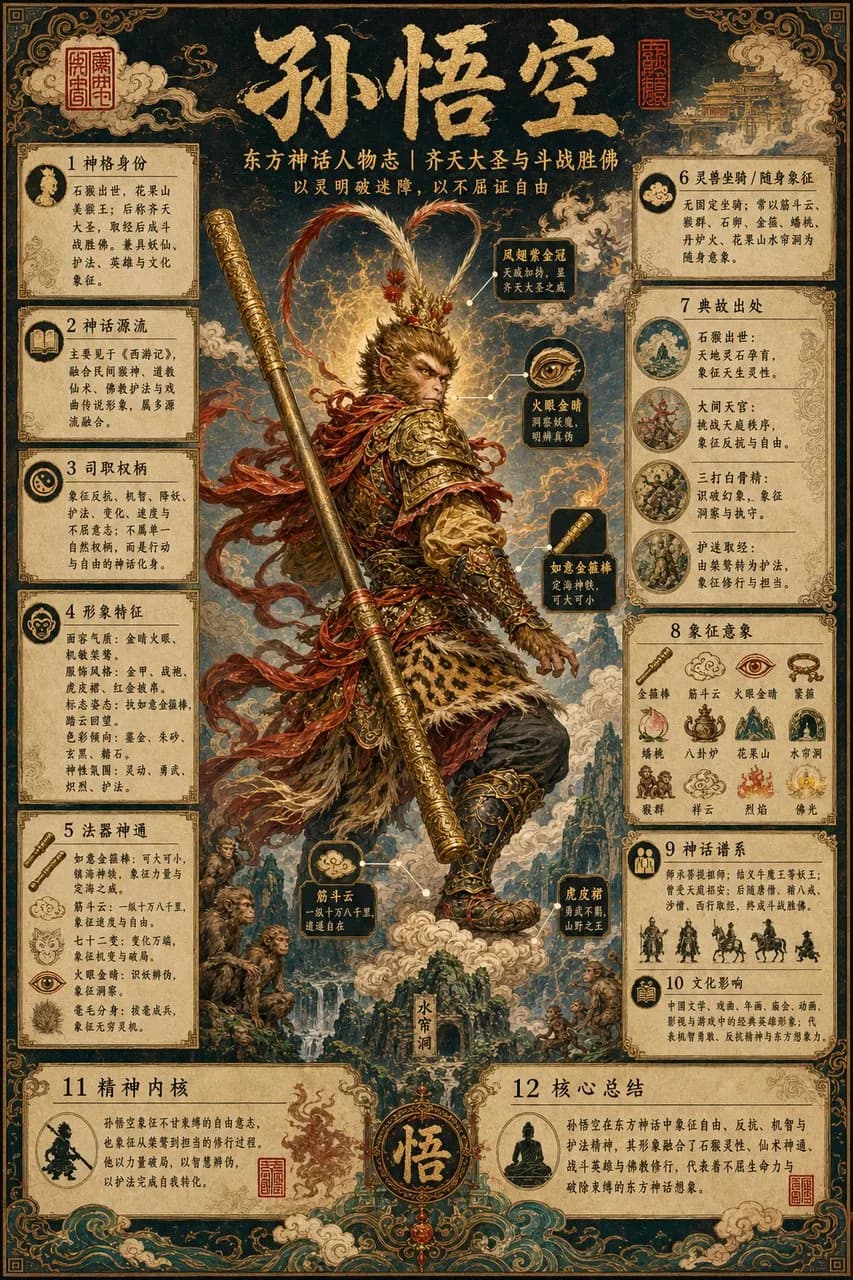
Eastern Mythology Character Encyclopedia Poster AI photo style example on PhotoReady
PhotoReady | photoready.kaamkardo.com
Custom Creator Style

Eastern Mythology Character Encyclopedia Poster

Created by
@gpt-image-2-library
Prompt source:@TanLuAIviaawesome-gpt-image-2

Rights holder? Request removal via our contact page.

#History & Classical Themes#UI#Infographic#Poster#Fashion#Story#History
Freeper generation
Secure transactions and inputs
Outputs completed in under 15 seconds
Powered by Photo Ready Engine
Use this prompt in

Every click copies the prompt. ChatGPT and Grok open with it already typed; the rest need one paste.

Prompt Template
Free Access
Please generate a vertical A4 poster for the 'Eastern Mythology Character Encyclopedia' based on [Sun Wukong]. You are a visual designer specializing in Eastern mythology, ancient texts, and infographics. Create a complete, visually cohesive character profile poster based on [Character Name] as known in Eastern mythology, folklore, ancient texts, operas, literature, or traditional culture. The most important principle: All content must revolve around [Character Name]; do not use generic deity templates. The character's image, magical tools, mounts, divine powers, anecdotes, symbols, and background must align with [Character Name]'s mythological setting. If there are multiple versions of the character, use the most widely recognized one; if there are variant texts, briefly note 'Versions vary.' Do not fabricate uncertain information; you may write 'Folklore contains variations' or 'Limited records exist.' Avoid using Norse runes, Viking totems, Gothic borders, Western armor, European castles, fantasy demon horns, or cyberpunk elements. The overall aesthetic must reflect Eastern mythology, not 'Western fantasy characters in Chinese clothing.' Overall visual style: Epic feel of Eastern mythology, blending the 'Shan Hai Jing' beast illustrations, Dunhuang murals, green landscapes, Tang dynasty figure paintings, Song and Yuan ancient paintings, bronze patterns, ancient text annotations, and talisman carving styles. The image should be solemn, mysterious, ancient, and luxurious yet restrained. Image composition: Vertical A4 poster with a symmetrical layout. The center features a full-body or half-body main visual of [Character Name], posed solemnly, with a sense of divinity and narrative. The character's clothing, crown, magical tools, expression, spirit beast, and background must align with the character's legend. Information cards are on both sides, with a core summary at the bottom. Surrounding patterns include cloud and thunder motifs, interlocking patterns, bronze textures, auspicious cloud patterns, scroll grass patterns, mountain sea patterns, and seal-style borders. Main title: '[Character Name]' Subtitle: 'Eastern Mythology Character Encyclopedia | Generated based on this character's mythological legend' Top spiritual motto: Automatically generate an elegant, concise, and philosophical motto based on [Character Name]'s core spirit. The motto should reflect the values, life stance, or spiritual core behind the character, not explanatory text. Do not write disclaimers like 'Not historically verified,' 'For reference only,' or 'Versions vary.' Limit to 12-28 characters, suitable for placement below the title. The motto should be highly tied to the character, avoiding vague phrases like 'Guardian of the living' or 'The path is boundless.' Please generate the following content sections: [1. Divine Identity] Explain [Character Name]'s identity within the Eastern mythology system. [2. Mythological Sources] Explain the main sources of this character from myths, ancient texts, folklore, novels, operas, or religious beliefs. [3. Responsibilities] Summarize the domains this character governs or symbolizes. [4. Character Traits] Describe the character's typical appearance, clothing, expression, posture, and visual aura. [5. Magical Tools] Showcase the character's most representative magical tools, weapons, talismans, or abilities. [6. Spirit Beasts / Symbols] If [Character Name] has mounts, spirit beasts, or accompanying symbols, display their names, forms, and meanings. If no clear mount exists, change to 'Accompanying Symbols' or 'Related Imagery.' Do not force every character to have dragons, phoenixes, cranes, or qilins. [7. Anecdotes] List 2-4 classic stories, legend fragments, or cultural anecdotes related to [Character Name]. Do not fabricate non-existent anecdotes. If versions vary, note 'Multiple versions exist.' [8. Symbolic Imagery] Extract the character's most core visual symbols. Symbols must relate to [Character Name]. [9. Mythological Genealogy] Explain the character's relationships with other mythological figures, factions, clans, or systems. If genealogy is unclear, write 'Genealogy varies.' [10. Cultural Influence] Explain the character's influence in folklore, festivals, rituals, literature, opera, painting, temples, film, or modern culture. [11. Spiritual Core] Summarize the spirit symbolized by this character from a mythological narrative perspective. Only analyze the mythological image, not infer the real person's character. [12. Core Summary] Use an elegant yet understandable summary in Chinese for [Character Name]: '[Character Name] symbolizes... in Eastern mythology, their image blends... and represents...'. Visual layout requirements: Top: Main title + Subtitle + Spiritual motto. Center: Main visual of the character, with a solemn atmosphere and rich details. Left column: Divine Identity, Mythological Sources, Responsibilities, Character Traits, Magical Tools. Right column: Spirit Beasts/Symbols, Anecdotes, Symbolic Imagery, Mythological Genealogy, Cultural Influence. Bottom: Spiritual Core + Core Summary. Small icons, annotation lines, ancient text labels, scroll cards, bronze plaques, vermilion seals, and talisman patterns may be added. Information cards should resemble ancient book pages, jade slips, bronze plates, scrolls, or inscriptions, not modern tech UI. Material and patterns: Rice paper texture, mineral pigments, gilded lines, vermilion seals, ink wash, bronze inscriptions, cloud and thunder patterns, interlocking patterns, auspicious cloud patterns, mountain water patterns, Dunhuang coffered ceiling patterns. Color rules: Automatically select Eastern color schemes based on [Character Name]'s attributes. Flames / Battle / Guardian: Vermilion, Black, Gilded, Crimson. Moon / Water / Cool Deities: Dark Blue, Silver, Moon White, Stone Blue. Mountains / Wood / Nature Deities: Stone Green, Indigo, Jade White, Ochre. Emperors / Celestial Court / Respected Deities: Gilded, Black, Vermilion, Jade White. Demons / Mythical Beasts: Black, Copper Green, Dark Gold, Red Ochre. Do not use the same color scheme for all characters. Text requirements: Chinese must be clear and readable, with a grand title and concise, accurate body text. Avoid garbled text, pseudo-characters, typos, overlapping text, or cutting. If space is limited, prioritize compressing the body while retaining all section titles. Avoid: Norse runes, Viking style, Gothic borders, Western armor, European castles, fantasy game UI, cyberpunk, excessive darkness, random dragons and phoenixes, irrelevant magical tools, templated deity images, unrelated anecdotes, and vague spiritual mottos.

Prompt explanation

The prompt anchors the model around history & classical themes, then narrows the output with outfit, background, lighting, pose, expression, and camera instructions. The most important variables to preserve are face identity, realistic skin texture, clear eyes, natural proportions, and the professional portrait lens with realistic depth of field look.

Editable variables

OutfitBackgroundLightingPoseExpressionCamera

Expected output

A realistic history & classical themes image with soft, realistic portrait lighting, a simple background that keeps attention on the face, a confident, approachable expression, and clear facial identity.

Common mistakes

  • Using a blurry or heavily cropped source photo.
  • Mixing formal and casual style instructions in the same prompt.
  • Adding too many props or background details.

Tips

  • Keep the clean, polished clothing that matches the intended use direction consistent with the final use case.
  • Preserve the soft, realistic portrait lighting and professional portrait lens with realistic depth of field terms when editing.
  • Use one clear face reference for the most reliable identity match.

Visual evidence for this style

Generated example for Eastern Mythology Character Encyclopedia Poster

Generated example

Create a vertical A4 poster for the 'Eastern Mythology Character Encyclopedia' featuring [Sun Wukong] with rich visuals and detailed mythological content.

Background detail for Eastern Mythology Character Encyclopedia Poster

Background detail

a simple background that keeps attention on the face

LinkedIn preview crop for Eastern Mythology Character Encyclopedia Poster

LinkedIn preview crop

a natural pose with clear face visibility with a confident, approachable expression.

About this style

Eastern Mythology Character Encyclopedia Poster is a history & classical themes style built for history & classical themes images, profile photos, and creator visuals. It combines clean, polished clothing that matches the intended use, a simple background that keeps attention on the face, soft, realistic portrait lighting, a natural pose with clear face visibility, and a confident, approachable expression so the generated image feels intentional rather than random. The goal is not only to copy a prompt, but to understand the visual system behind the output.

This style is especially useful for professionals because it keeps the result focused on credibility, facial clarity, and repeatable framing. The professional portrait lens with realistic depth of field direction helps the image look closer to a real portrait session, while the background and lighting choices reduce distractions that can weaken a profile photo, resume image, creator bio, or portfolio thumbnail.

For best results, start with a sharp source image where the face is unobstructed and the head is not heavily cropped. Keep the outfit and background aligned with the final use case: more formal for LinkedIn, resumes, company pages, and founder bios; softer and more expressive for creator profiles, social media, and personal branding.

Structured style metadata

Category
History & Classical Themes
Use case
history & classical themes images, profile photos, and creator visuals

Best use cases for Eastern Mythology Character Encyclopedia Poster

Create a vertical A4 poster for the 'Eastern Mythology Character Encyclopedia' featuring [Sun Wukong] with rich visuals and detailed mythological content.

Who should use it

This style fits professionals who need a polished image for history & classical themes images, profile photos, and creator visuals. It is useful when the photo needs to look credible, current, and easy to reuse across professional profiles.

Why this works

The combination of soft, realistic portrait lighting, a simple background that keeps attention on the face, and a confident, approachable expression makes the final image readable at small profile-photo sizes while still feeling realistic at full size.

Outfit guide

Use clean, polished clothing that matches the intended use. Avoid clothing that fights the style direction, especially busy patterns, oversized logos, or colors that clash with the background.

Background guide

The best background is a simple background that keeps attention on the face. It should support the subject without making the final image look staged, crowded, or overly decorative.

Camera and expression guide

Keep professional portrait lens with realistic depth of field, a natural pose with clear face visibility, and a confident, approachable expression. These details help the output read like a real portrait rather than a generic AI image.

Common questions about the Eastern Mythology Character Encyclopedia Poster style

Is the Eastern Mythology Character Encyclopedia Poster style free?

Yes. You can copy this style prompt directly from this page and use it in your own image tool.

What source photo works best with this style?

Use a clear portrait with good lighting, an unobstructed face, and minimal blur for the most realistic result.

Can I adapt the prompt?

Yes. Keep the core camera, lighting, and mood terms, then swap details such as outfit, background, or occasion. For this style the terms worth preserving are professional portrait lens with realistic depth of field and soft, realistic portrait lighting.

Which professions suit the Eastern Mythology Character Encyclopedia Poster style?

It works best for professionals, and can be adapted for adjacent roles by changing outfit, background, and expression details.

What should I avoid?

Avoid low-resolution uploads, covered faces, extreme filters, crowded backgrounds, and instructions that conflict with the style metadata.

Can this style be used for a LinkedIn profile photo?

Yes, especially when the outfit, background, expression, and crop match the professional audience you want to reach. LinkedIn crops profile photos to a circle, so keep the face centred.

Related guides

More styles like this
Photo Ready Logo
Photo Ready